Lookly
Lookly
Lookly
Promoting repeated clothing use through a behaviour changing strategy to reduce laundry's environmental impact.
Promoting repeated clothing use through a behaviour changing strategy to reduce laundry's environmental impact.
Promoting repeated clothing use through a behaviour changing strategy to reduce laundry's environmental impact.
Duration
Duration
Duration
4 Weeks
4 Weeks
4 Weeks
Type
Type
Type
Individual Student Project
Individual Student Project
Individual Student Project
Responsibilities
Responsibilities
Responsibilities
User research, Data Analysis, Ideation, Prototype, and Test
User research, Data Analysis, Ideation, Prototype, and Test
User research, Data Analysis, Ideation, Prototype, and Test
PROBLEM
PROBLEM
Doing laundry is part of our routine, making it easy to overlook its negative environmental impact. Despite technological advancements, the overall energy consumption is still rising Laitala et al. (2011).
Any action to do laundry sustainably will be insignificant if the frequency remains high.
Doing laundry is part of our routine, making it easy to overlook its negative environmental impact. Despite technological advancements, the overall energy consumption is still rising Laitala et al. (2011).
Any action to do laundry sustainably will be insignificant if the frequency remains high.
Doing laundry is part of our routine, making it easy to overlook its negative environmental impact. Despite technological advancements, the overall energy consumption is still rising Laitala et al. (2011).
Any action to do laundry sustainably will be insignificant if the frequency remains high.
💡
💡
💡
How might we prompt female students living independently to wear their clothes more before washing them?
How might we prompt female students living independently to wear their clothes more before washing them?
How might we prompt female students living independently to wear their clothes more before washing them?
SOLUTION
SOLUTION
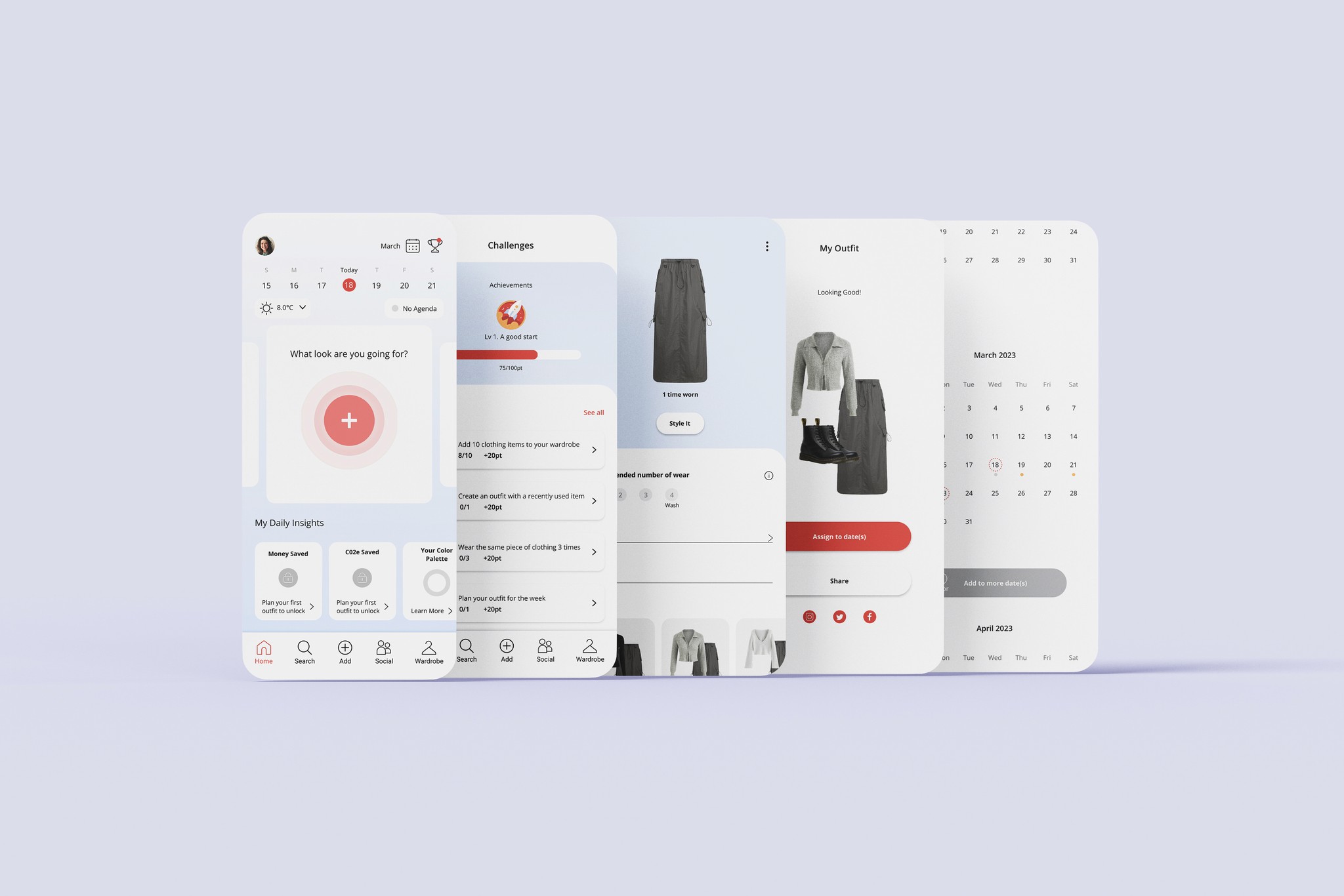
Make the Most Out of Your Wardrobe
Use gamification to guide the change in wearing frequency
Suggest use frequency based on material, weather, and user activity.
Prompt you to assign an outfit to multiple dates, increasing the use frequency.
Make the Most Out of Your Wardrobe
Use gamification to guide the change in wearing frequency
Suggest use frequency based on material, weather, and user activity.
Prompt you to assign an outfit to multiple dates, increasing the use frequency.
Make the Most Out of Your Wardrobe
Use gamification to guide the change in wearing frequency
Suggest use frequency based on material, weather, and user activity.
Prompt you to assign an outfit to multiple dates, increasing the use frequency.
Learn the Cause and Effect to Form a New Habit*
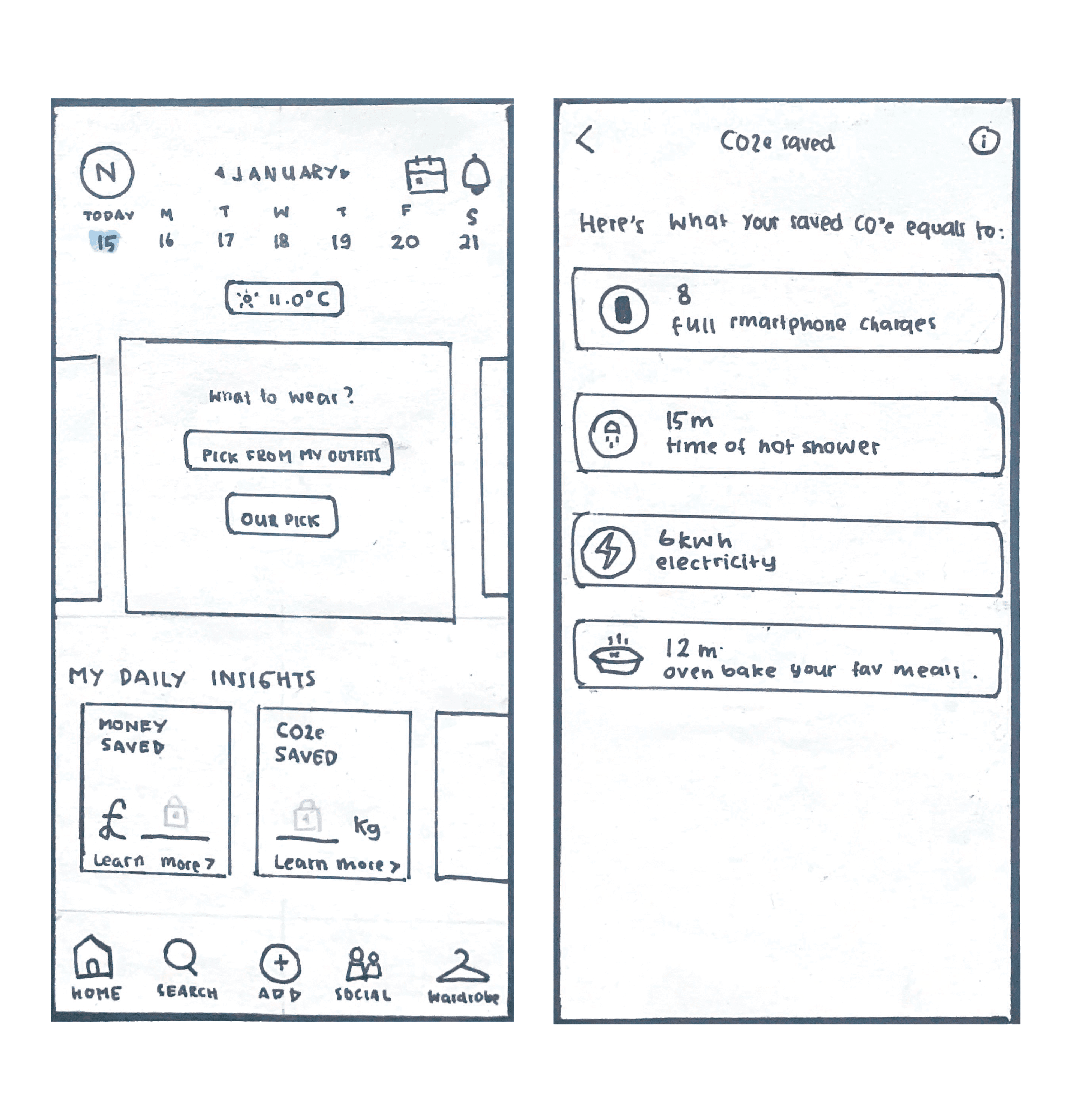
Get feedback on the money and CO2e saved from complying.
Convert savings to everyday things to help you understand, making it feels worthwhile.
*according to Manning (2009)
Learn the Cause and Effect to Form a New Habit*
Get feedback on the money and CO2e saved from complying.
Convert savings to everyday things to help you understand, making it feels worthwhile.
*according to Manning (2009)
Learn the Cause and Effect to Form a New Habit*
Get feedback on the money and CO2e saved from complying.
Convert savings to everyday things to help you understand, making it feels worthwhile.
*according to Manning (2009)
HOW I GOT THERE
HOW I GOT THERE
Discover
Secondary Research
Contextual Interview
Participant observation
Define
Affinity Diagram
Insights
HMW Statements
Develop
Artefacts Behaviour Change Strategy Card
Deliver
Low-Fi Prototype
Evaluation
RESEARCH QUESTION
RESEARCH QUESTION
I first explored the problem space and stumbled upon eye-opening research that cleanliness is a state of mind rather than a physical fact (Klint, Johansson and Peters, 2022). This research intrigued my curiosity and led me to the research question.
I must understand how the target user identifies dirty laundry to extend the wear cycle.
I first explored the problem space and stumbled upon eye-opening research that cleanliness is a state of mind rather than a physical fact (Klint, Johansson and Peters, 2022). This research intrigued my curiosity and led me to the research question.
I must understand how the target user identifies dirty laundry to extend the wear cycle.
I first explored the problem space and stumbled upon eye-opening research that cleanliness is a state of mind rather than a physical fact (Klint, Johansson and Peters, 2022). This research intrigued my curiosity and led me to the research question.
I must understand how the target user identifies dirty laundry to extend the wear cycle.
RESEARCH
RESEARCH
To help me get the answer, I did the contextual interview and participant observation with three participants. Combining these two methods bridged the gap between their thoughts and actions.
To help me get the answer, I did the contextual interview and participant observation with three participants. Combining these two methods bridged the gap between their thoughts and actions.
To help me get the answer, I did the contextual interview and participant observation with three participants. Combining these two methods bridged the gap between their thoughts and actions.
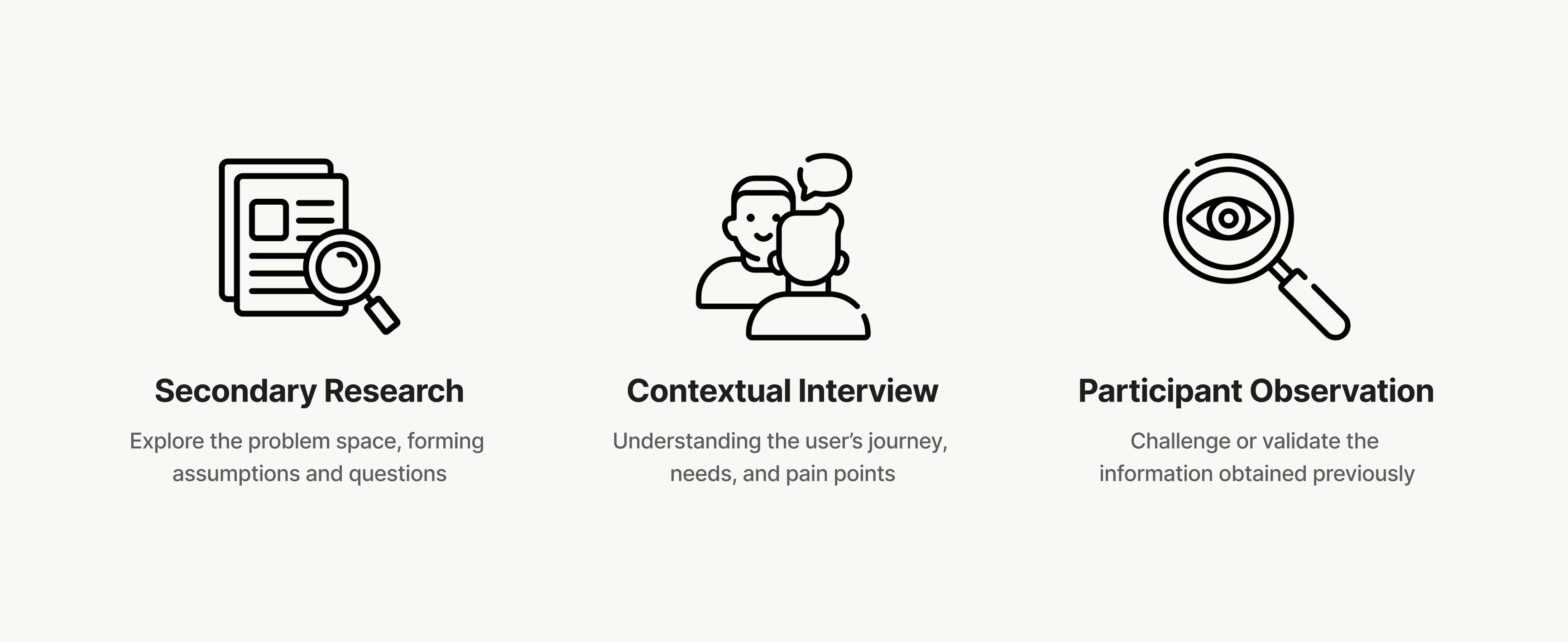
I wasn't present at the key moment when they identified dirty laundry for ethical reasons. However, I got the necessary data by prompting them to recall why they placed the clothes on the dirty laundry pile as they loaded the washing machine.
I wasn't present at the key moment when they identified dirty laundry for ethical reasons. However, I got the necessary data by prompting them to recall why they placed the clothes on the dirty laundry pile as they loaded the washing machine.
I wasn't present at the key moment when they identified dirty laundry for ethical reasons. However, I got the necessary data by prompting them to recall why they placed the clothes on the dirty laundry pile as they loaded the washing machine.
DATA ANALYSIS
DATA ANALYSIS
Turning Insights into Opportunities
I used the POEMS framework to make sense of the observational data before combining it with my interview findings in an affinity diagram to form insights.
I used the POEMS framework to make sense of the observational data before combining it with my interview findings in an affinity diagram to form insights.
I used the POEMS framework to make sense of the observational data before combining it with my interview findings in an affinity diagram to form insights.
Insight 01
Their desire for a positive self-image leads them to avoid wearing the same clothes repeatedly, causing more frequent laundry.
Opportunity 01
Socially reward users for wearing the same clothes repeatedly.
Visualise ways to style clothes differently.
Insight 02
Their laundry frequency is based on habit, even with the ever-changing environment, not knowing whether the clothes are dirty.
Opportunity 02
Enable habit formation by providing feedback on cause and effect.
Recommend clothing usage frequency based on material, weather, etc.
DEVELOP
DEVELOP
I generated HMW statements based on the insights, choosing the one with the highest desirability and effectiveness with an evaluation matrix.
How might we visualise different ways of
wearing the same clothes?
BEHAVIOUR CHANGING STRATEGIES
BEHAVIOUR CHANGING STRATEGIES
Crafting the experience
To create a solution that can potentially transform the target user's behaviour, I used the Behaviour Change Strategy Card to craft the experience (Artefacts, n.d.). Here are the three key applications:
To create a solution that can potentially transform the target user's behaviour, I used the Behaviour Change Strategy Card to craft the experience (Artefacts, n.d.). Here are the three key applications:
To create a solution that can potentially transform the target user's behaviour, I used the Behaviour Change Strategy Card to craft the experience (Artefacts, n.d.). Here are the three key applications:
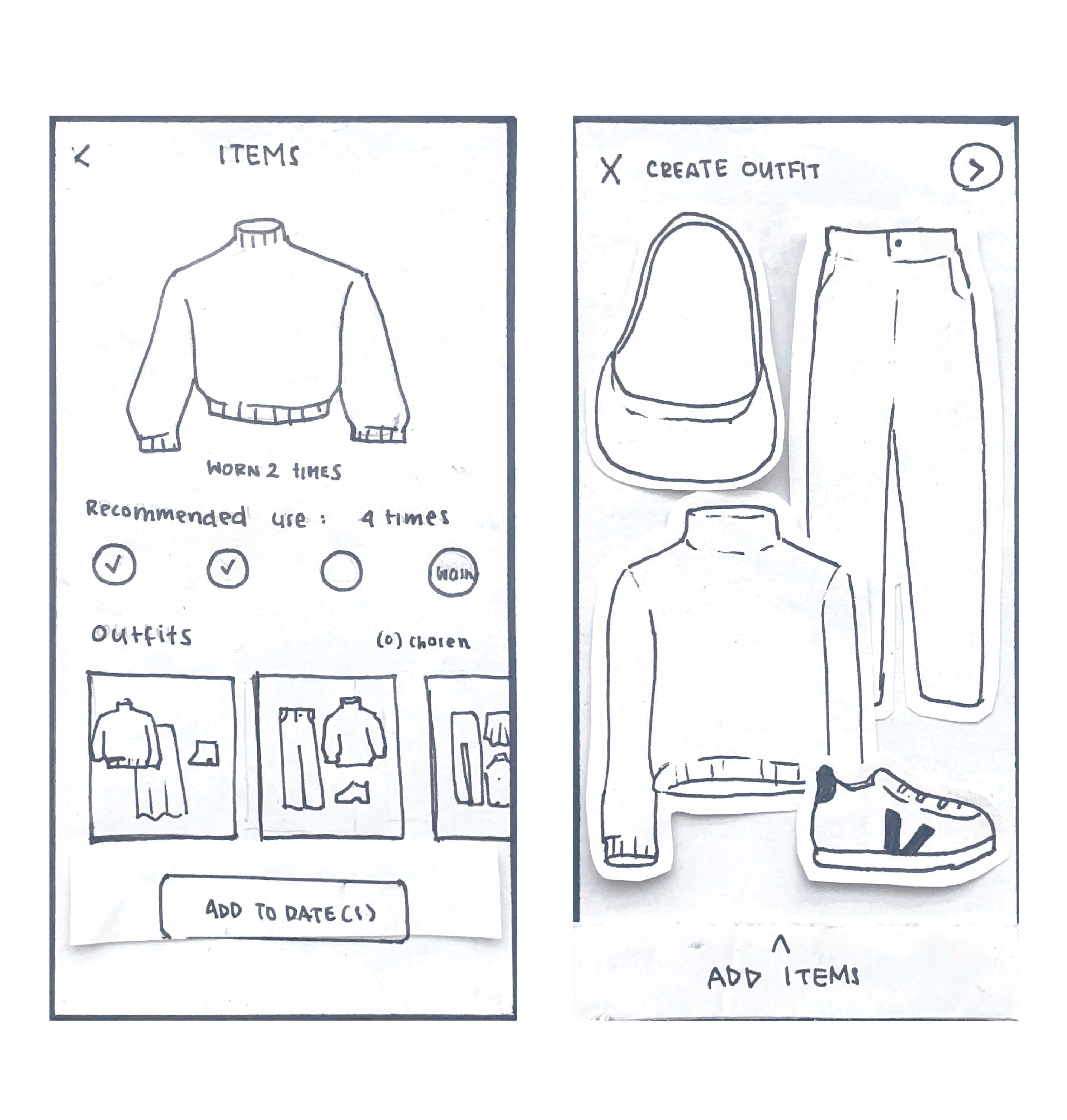
Strategy 01
How might we put users in control?
Allow users to create their outfits while guiding them to use clothes more frequently using constraints and feedback.
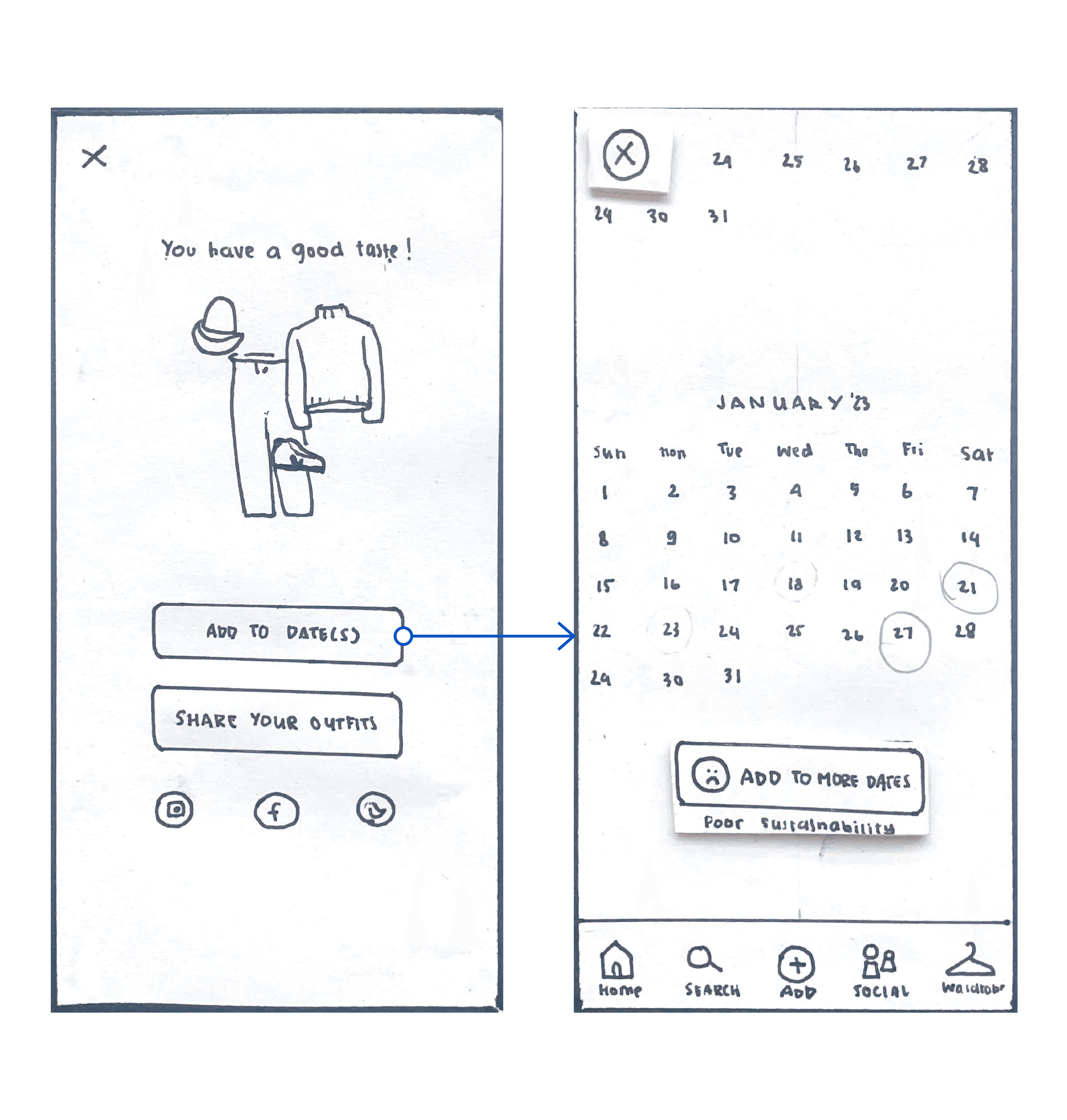
Strategy 02
How might we help people pre-commit to a desired behaviour?
Prompt users to assign the outfit to future dates, making them commit in advance. Guide users towards desired behavior by restricting further action until an appropriate number of dates is selected.
Strategy 03
How might we emphasise gains associated with this behaviour?
Provide feedback on the money and CO2e saved from complying, converting savings to everyday items to make it tangible.
PROTOTYPE + TESTING
PROTOTYPE + TESTING
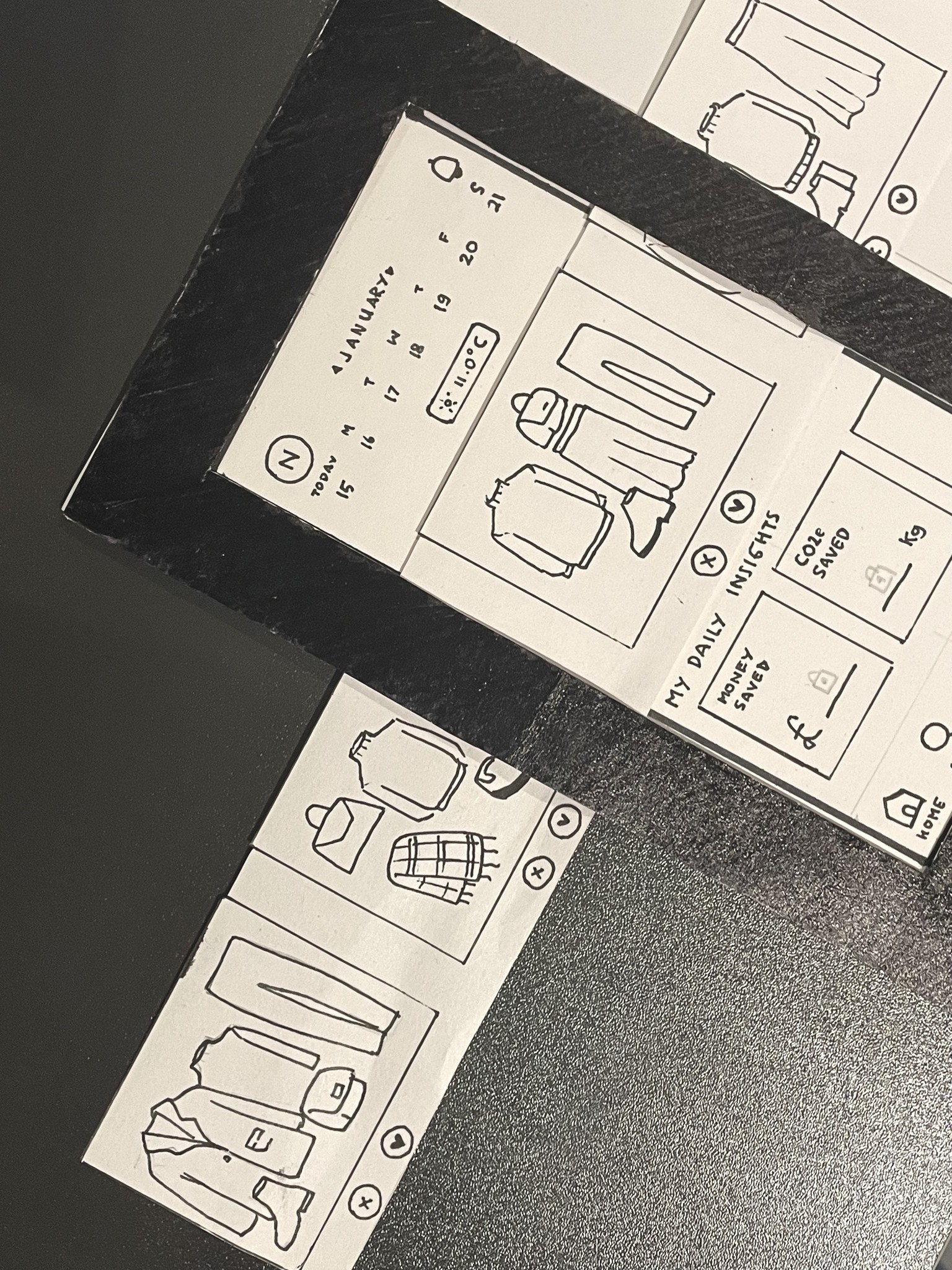
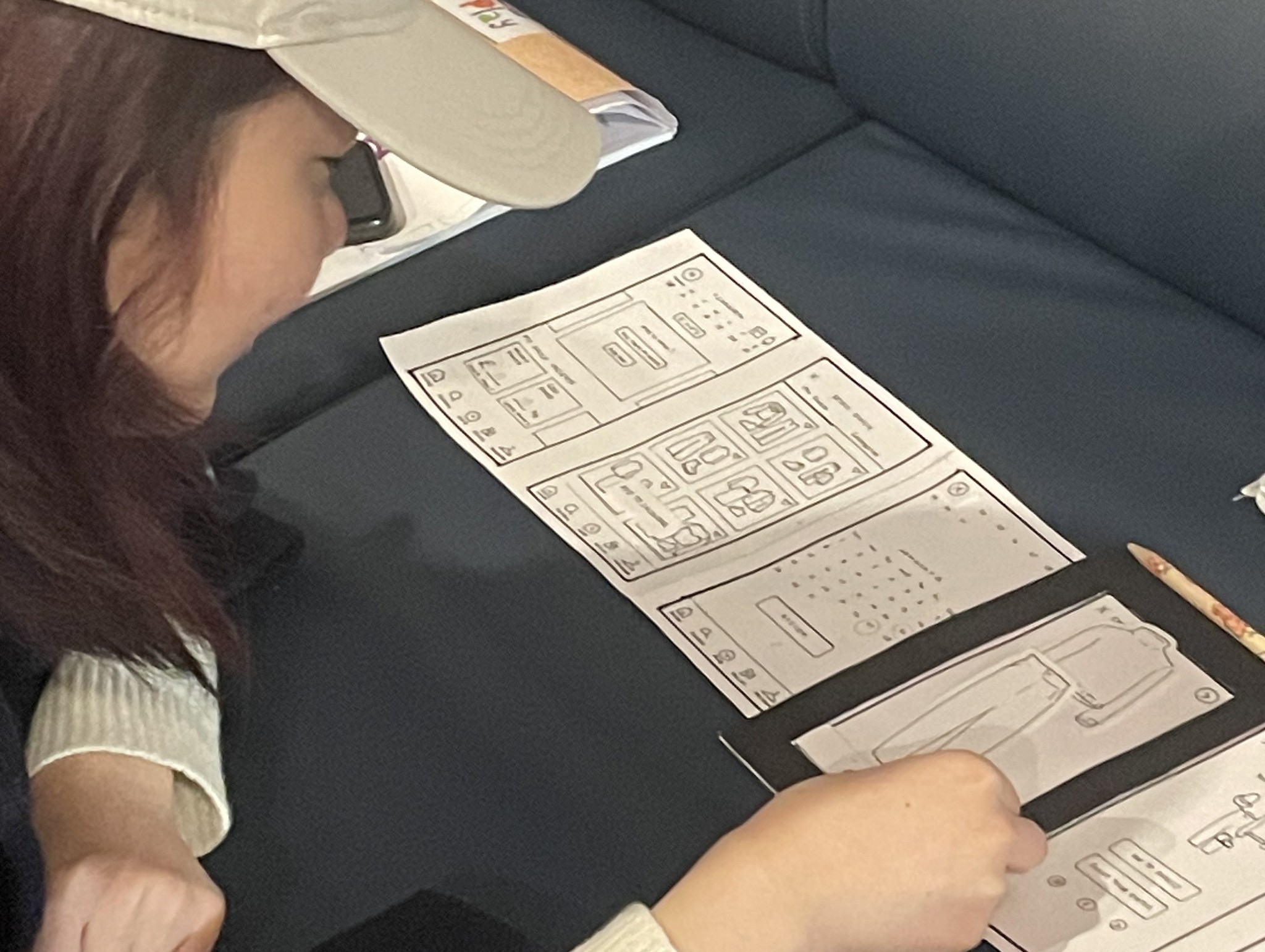
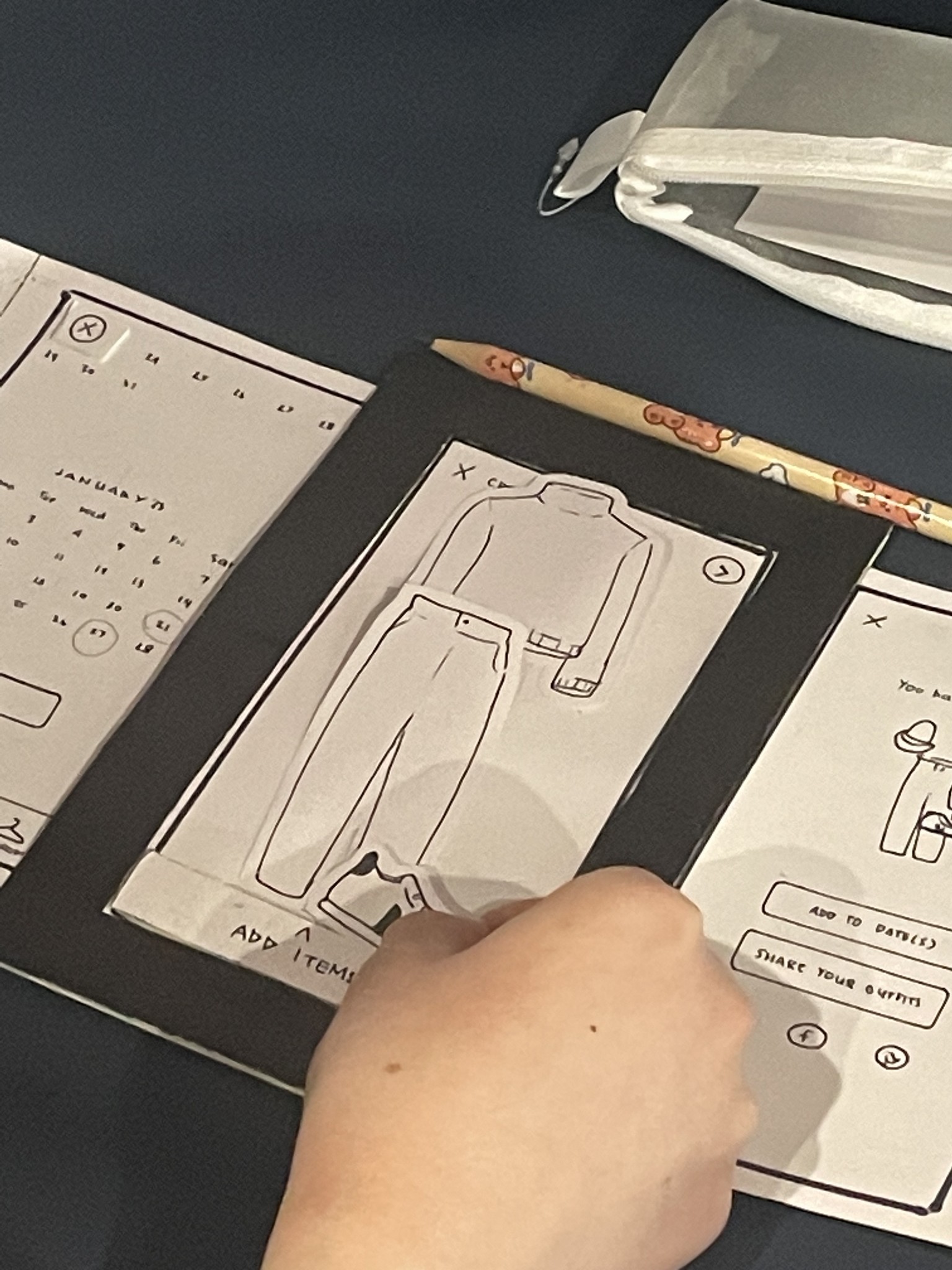
I used a low-fi prototype to assess the product based on functionality, behaviour impact, and sustainability (Wilson, 2013). To do this, participants were asked to think aloud while completing the given task, followed by an interview. Here are the results:
I used a low-fi prototype to assess the product based on functionality, behaviour impact, and sustainability (Wilson, 2013). To do this, participants were asked to think aloud while completing the given task, followed by an interview. Here are the results:
I used a low-fi prototype to assess the product based on functionality, behaviour impact, and sustainability (Wilson, 2013). To do this, participants were asked to think aloud while completing the given task, followed by an interview. Here are the results:
The good news is..
100%
would rethink before putting their clothes on the dirty laundry pile
would rethink before putting their clothes on the dirty laundry pile
The bad news is..
75%
are unsure if they would engage with the app long enough for habits to form.
don't do budgeting
KEY ITERATIONS
KEY ITERATIONS
Identifying the blockers for future iterations.
Based on user feedback, we identified the key blockers that preventing the user from engaging with the app long enough for a new habit to form.

P1
P1
P1
Female, 27 y.o
Female, 27 y.o
Male
23 y.o
”I would feel overwhelmed using the app due to the number of clothes I have to upload.”
”I would feel overwhelmed using the app due to the number of clothes I have to upload.”
”I would feel overwhelmed using the app due to the number of clothes I have to upload.”
Iteration 01
Apply gamification to break it into smaller and achievable goals.
Iteration 01
Apply gamification to break it into smaller and achievable goals.
Remind them of the goal at stake when alerting the user to show the consequence of overspending.

P1
P1
P1
Female, 24 y.o
Female, 24 y.o
Female
24 y.o
”I can't plan an outfit too far ahead because it depends on the events and who I meet with.”
”I can't plan an outfit too far ahead because it depends on the events and who I meet with.”
”I can't plan an outfit too far ahead because it depends on the events and who I meet with.”
Iteration 02
Sync the app with calendars to give better suggestions or let the user plan accordingly.
Iteration 02
Sync the app with calendars to give better suggestions or let the user plan accordingly.
Iteration 02
Sync the app with calendars to give better suggestions or let the user plan accordingly.

P2
P2
P2
Female, 22 y.o
Female, 22 y.o
Female, 22 y.o
" I might not stick to the planned outfit and use something else instead.”
" I might not stick to the planned outfit and use something else instead.”
" I might not stick to the planned outfit and use something else instead.”
Iteration 03
Send reminders and enable social sharing to create accountability, motivating users to wear the planned outfit.
Iteration 03
Send reminders and enable social sharing to create accountability, motivating users to wear the planned outfit.
Iteration 03
Send reminders and enable social sharing to create accountability, motivating users to wear the planned outfit.
REFLECTIONS
REFLECTIONS
This was my first opportunity to experience an entire UX process. A few things I've learned:
The foundation of research should always be a thoughtful question. I couldn't get the most out of my research because I chose the methods before defining the research question. This approach left me needing more guidance and focus.
A designer has the power to change users' behaviour, which means I have a big responsibility to ensure the well-being and autonomy of users. I must always align my design with ethical principles.
I must design with agility. I conducted my first-ever interview on this project. It was challenging to have an engaging conversation due to the uncontrolled environment. I should've adjusted my approach, considering alternative methods.
This was my first opportunity to experience an entire UX process. A few things I've learned:
The foundation of research should always be a thoughtful question. I couldn't get the most out of my research because I chose the methods before defining the research question. This approach left me needing more guidance and focus.
A designer has the power to change users' behaviour, which means I have a big responsibility to ensure the well-being and autonomy of users. I must always align my design with ethical principles.
I must design with agility. I conducted my first-ever interview on this project. It was challenging to have an engaging conversation due to the uncontrolled environment. I should've adjusted my approach, considering alternative methods.
This was my first opportunity to experience an entire UX process. A few things I've learned:
The foundation of research should always be a thoughtful question. I couldn't get the most out of my research because I chose the methods before defining the research question. This approach left me needing more guidance and focus.
A designer has the power to change users' behaviour, which means I have a big responsibility to ensure the well-being and autonomy of users. I must always align my design with ethical principles.
I must design with agility. I conducted my first-ever interview on this project. It was challenging to have an engaging conversation due to the uncontrolled environment. I should've adjusted my approach, considering alternative methods.
NEXT STEPS
NEXT STEPS
If I had more time, I would conduct a diary study. This would allow me to get real-time data instead of relying on their recollection to improve accuracy.
Evaluate the product over an extended period to assess its potential for long-term use, minimising the risk of users quitting the app before a new habit can be formed.
Conduct another round of usability testing with the high-fidelity prototype.
If I had more time, I would conduct a diary study. This would allow me to get real-time data instead of relying on their recollection to improve accuracy.
Evaluate the product over an extended period to assess its potential for long-term use, minimising the risk of users quitting the app before a new habit can be formed.
Conduct another round of usability testing with the high-fidelity prototype.
If I had more time, I would conduct a diary study. This would allow me to get real-time data instead of relying on their recollection to improve accuracy.
Evaluate the product over an extended period to assess its potential for long-term use, minimising the risk of users quitting the app before a new habit can be formed.
Conduct another round of usability testing with the high-fidelity prototype.
REFERENCES
REFERENCES
Artefact (n.d.) Behavior Change Strategy Cards. Available at: https://www.artefactgroup.com/case-studies/behavior-change-strategy-cards/ (Accessed: 14 January 2023).
Klint, E., Johansson, L.-O. and Peters, G. (2022) No stain, no pain – A multidisciplinary review of factors underlying domestic laundering. Energy Research & Social Science, 84, p.102442.
Laitala, K., Boks, C. and Klepp, I.G. (2011) ‘Potential for environmental improvements in laundering’, International Journal of Consumer Studies, 35(2), pp. 254–264.
Manning, C. (2009) The Psychology of Sustainable Behavior: Tips for empowering people to take environmentally positive action. St. Paul, MN: Minnesota Pollution Control Agency.
Wilson, G.T. (2013) ‘Design for Sustainable Behaviour: Feedback Interventions to Reduce Domestic Energy Consumption’, Loughborough University, pp. 185-215.
Artefact (n.d.) Behavior Change Strategy Cards. Available at: https://www.artefactgroup.com/case-studies/behavior-change-strategy-cards/ (Accessed: 14 January 2023).
Klint, E., Johansson, L.-O. and Peters, G. (2022) No stain, no pain – A multidisciplinary review of factors underlying domestic laundering. Energy Research & Social Science, 84, p.102442.
Laitala, K., Boks, C. and Klepp, I.G. (2011) ‘Potential for environmental improvements in laundering’, International Journal of Consumer Studies, 35(2), pp. 254–264.
Manning, C. (2009) The Psychology of Sustainable Behavior: Tips for empowering people to take environmentally positive action. St. Paul, MN: Minnesota Pollution Control Agency.
Wilson, G.T. (2013) ‘Design for Sustainable Behaviour: Feedback Interventions to Reduce Domestic Energy Consumption’, Loughborough University, pp. 185-215.
Artefact (n.d.) Behavior Change Strategy Cards. Available at: https://www.artefactgroup.com/case-studies/behavior-change-strategy-cards/ (Accessed: 14 January 2023).
Klint, E., Johansson, L.-O. and Peters, G. (2022) No stain, no pain – A multidisciplinary review of factors underlying domestic laundering. Energy Research & Social Science, 84, p.102442.
Laitala, K., Boks, C. and Klepp, I.G. (2011) ‘Potential for environmental improvements in laundering’, International Journal of Consumer Studies, 35(2), pp. 254–264.
Manning, C. (2009) The Psychology of Sustainable Behavior: Tips for empowering people to take environmentally positive action. St. Paul, MN: Minnesota Pollution Control Agency.
Wilson, G.T. (2013) ‘Design for Sustainable Behaviour: Feedback Interventions to Reduce Domestic Energy Consumption’, Loughborough University, pp. 185-215.